
Instructor: Prof. Veronica Montes
Course Description (by Prof. Montes)
For its unique history, the number of migrants, and the two countries’ proximity, Mexican migration to the United States represents an exceptional case in world migration. There is no other example of migration with more than 100 years of history. The copious presence of migrants concentrated in a host country, such as we have in the case of the 11.7 million Mexican migrants residing the United States, along with another 36.3 million Mexican descendants, is unparalleled. The 1,933-mile-long border shared by the two countries makes it one of the longest boundary lines in the world and, unfortunately, also one of the most dangerous frontiers in the world today. In this participatory course, we will examine the different economic, political, historical, social and cultural forces that have shaped this centenarian migration influx. We will undertake a macro-, meso-, and micro-levels of analysis. At the macro-level of political economy, we will investigate the economic interdependency that has developed between Mexico and the US over different economic development periods of these countries. Particularly, we will examine the role the Mexican labor force has played to boosting and sustaining both the Mexican and the American economies. At the meso-level, we will examine different institutions both in Mexico and in US that have determined the ways in which millions of Mexicans migrate to this country. Last, but certainly not least, we will explore the impacts that both the macro- and meso-processes have had on the micro-level, by considering the imperatives, aspirations, and dreams that have prompted millions of people to leave their homes and communities behind in search of better opportunities. This major life decision of migration brings with it a series of social transformations in family and community networks, this will investigate the cultural impacts in both the sending and receiving migrant communities. In sum, we will come to understand how these three levels of analysis work together.
 This photograph of the students and guest speakers on the panel in the restaurant speaks volumes for me as it represents the importance of community-building between migrants and demonstrates the great impact that hearing testimonies of immigrants has. The students in this picture are a vehicle for the guest speaker’s stories to come to life, and allow the speakers to give their own perspectives on the life of a Mexican immigrant. Each guest speaker illustrated their journey to America and the obstacles they have faced over the years as they resist assimilation and celebrate their roots. Javier expressed the importance of worker’s rights and the lack of protection of undocumented workers in the realm of construction. This relates back to the film we have watched in class, “The Hand that Feeds”, as it pertains to undocumented worker’s rights and how difficult it is for immigrants to unionize and advocate for better working conditions and pay, as they fear the possibility of being deported. Alma, the owner of the restaurant, echoed this sentiment as she experienced the threat of being deported while attempting to purchase a space for her restaurant.
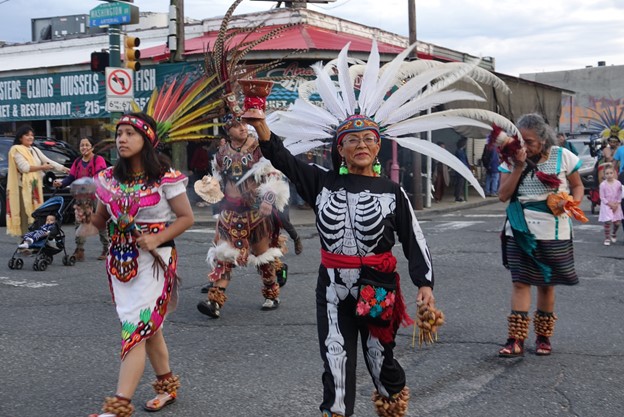 I chose this photo because I feel like it includes a lot all in one image. First, it shows four different people who are participating as dancers in the parade. I think the variety of who these people are is really meaningful, especially the two women in the front, one who is older and one who is younger. I think this speaks to the importance of tradition as a manner of connecting different generations and as a way of maintaining and passing down culture. I also just like the pose of the woman with the white headdress and her smile and look of pride.
 My name is Sunny Martinez, I am a sophomore at Haverford College and I plan to major in political science. We had the amazing opportunity to get to hear the personal stories of migrants who have been doing work to move the community forward and also to eat at one of their restaurants as well as explore the community and celebrate the day of the dead. In this photograph the class is listening to the speakers from the community. I am the one with pink hair sitting in the front row. I can still remember what I was thinking and feeling during the talk. There was a point where I had tears in my eyes because what was being said was so incredibly powerful. I really appreciated the strength of each and every one of them and admired their vulnerability.
 When I was scrolling down through the array of photos taken the day of the Southern Philadelphia trip my initial thought was that all the images translated a sense of belongingness. The photograph I choose came at the culmination of the panel of speakers that shared their migratory experiences and their entrepreneur journeys with our Mexican American communities class. The panel of speakers was perhaps the most touching moment for me throughout the entire experience, as it symbolized a form of storytelling that was reminiscent of the Latino community that I was raised in and expanded on the emotional ties that root migrants to cities like Philadelphia. I believe that hearing firsthand the struggles and resilience of the speakers when they spoke about their years building up their businesses and their activism in the community was much more impactful than hearing their voices translated into texts.
 Throughout this course, we’ve discussed the long history of oppression of Mexican migrants. Migrants have always been perceived as commodities, never as human beings, and so, they have always been mistreated. We have seen how emotional and traumatic their journeys to the U.S. have been, and the hardships that they constantly undergo from the time they decided to leave Mexico to navigating the U.S., sometimes alone. In particular, reading about the traumatic effects of the Bracero program was difficult because families were separated and Braceros were abused and never given adequate compensation.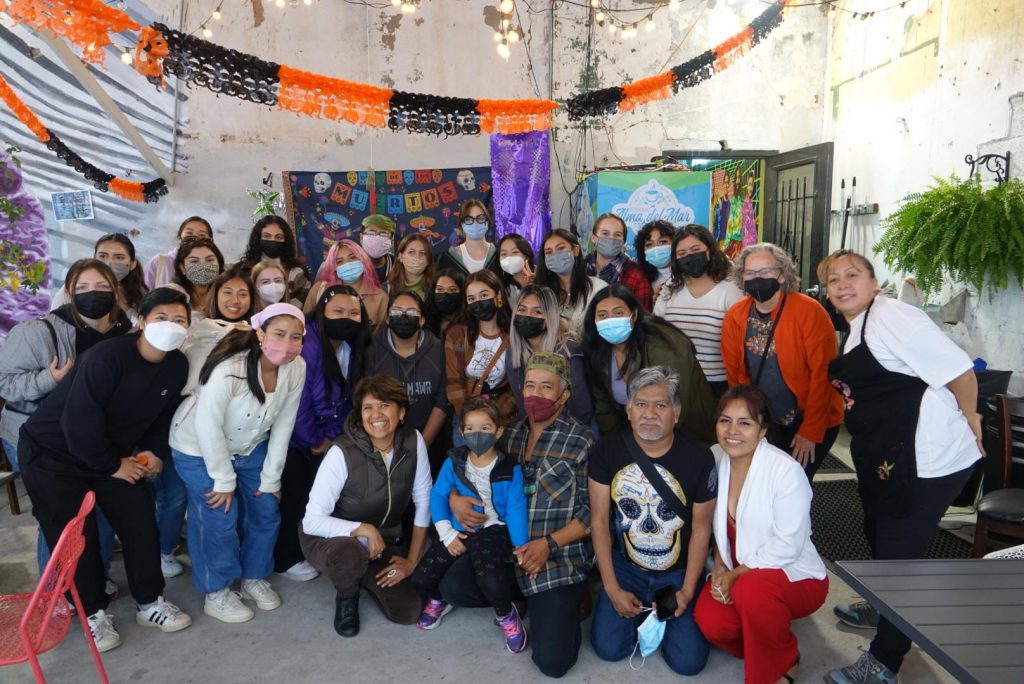
 This photo speaks to me for a variety of reasons. The beautiful Katrinas stick out in their bold
 This photograph embodies belonging, culture, resistance, art, and individualism. These are all key concepts which are important in any culture but are especially important in Mexican American culture. Dia de los muertos is an important celebration for the Mexicans. This Catrina is a symbol for the celebration but for me it is an example of how the Mexican American culture here in Philly can express and resist racist systemic institutions. Through this resistance and expression of their culture it strengthens the community and creates a sense of belonging as they celebrate part of their home country and “echando raices” (setting their roots) in a new unfamiliar country. La Catrina represents the beauty of Mexican art. It has intricate detailing on the dress, the head piece, and the makeup. This photograph encompasses so much beauty it’s an example of finding belonging in a community which through this celebration can resist a country full of hatred and unacceptance in being proud of their own identity and culture.
 I chose this specific image from our trip to South Philly because it was a moment in my culture that I never got to learn about growing up. I can’t remember a moment where I was in class and learned about myself but I knew plenty about the history of how the colonizers set sail from Europe and how they conquered the supposedly “New World” that was North America. When the reality was North America had always been there with its own inhabitants living peacefully undisturbed until they were conquered and with a majority of their history lost. They thought the Native Americans were primitive even after they taught the white man how to plant and harvest crops to survive. The colonizers were mentored by the Native Americans who learned to live and respect the land. This has become a recurring theme we see in the history of America. Americans will condemn the very work they are dependent on to live comfortably.
 This semester, I had the wonderful opportunity to take Mexican American Communities, a Praxis course based in the Sociology Department and taught by Professor Montes. I was initially drawn to it by not only its macro and meso-level analyses of the US-Mexico migration, but also by its focus at the micro-level, exploring how migration has directly affected Mexican migrants, their families and communities and their daily experiences. On October 30th, our class took a field trip to South Philadelphia where we were able to meet community members and hear each of their unique migration stories. This photograph captures one of my favorite moments: our class learning about the realities and hardships of US-Mexican migration but also the moments of joy and healing that emerges from finding a sense of belonging and a community that reminds you of home in an unfamiliar land.
 This photograph is of the Dia de Los Muertos Parade going through Broad St. in South Philadelphia. The parade was one of the highlights of the day for me. I remember entering the parade right as we left Alma del Mar, where we enjoyed some fresh seafood tacos and heard from Mexican American business owners on their experiences migrating to and living in South Philadelphia. Up until the point of the parade, I felt like we were outsiders looking into a window of what life is like in South Philadelphia for the day. Walking in the parade, much like the people in this image, we became part of the community and celebrated alongside them throughout the day.
 This image spoke to me because it emphasized the importance of tradition and continuing it even when far away from home. These ofrendas are common in México during Dia De Los Muertos. However, this is not a custom done in the United States. By creating these ofrendas and sharing them with the community, people can get a sense of nostalgia from looking at them. This plays into what we have discussed in class about nostalgia products. While the ofrenda is not a product, it does produce a feeling of nostalgia and remembrance of Mexico. This creates a space where people can feel like they belong and have their own community. The ofrenda creates nostalgia for the celebration that migrants remember in Mexico. By creating the ofrenda and other aspects of Dia de Los Muertos here in Philadelphia, migrants can still feel connected to their roots while they are in Philadelphia. These kinds of spaces are so important, as they help toward building community and being a space of both collaboration and remembrance.
 I picked this photo of a woman dressed in a traditional head garment who is performing a native dance. Indigenous and Hispanics of indigenous decent are often forgotten about in the discussion of Hispanics. Our languages are often forgotten under the guise that ‘all Hispanics speak Spanish.’ While Spanish is very sacred part of our culture, millions of Mexicans speak an Indigenous language.
 Over the course of the semester, I’ve had the experience of learning and submerging myself in what it means to be a Mexican migrant, the challenges that migrants face, and how migrants adapt to living in a new country. Not only have I learned the complexities of Mexican migration, but I have also learned of these aspects from a sociological perspective through the use of readings, films, and most importantly in-person field trips. Learning through a sociological perspective is important to me, because it helps me better understand the process in which things occur and why they occur. It further helps me understand different systems and structures, such as politics, migration, race, identity, belonging, social justice, etc., and how they interconnect in ways that impact certain groups, in this case Mexican migrants, and society as a whole.
 This photograph speaks to me because it brings me back to Alma del Mar, where we learned about the stories of migrants. Listening to these stories was incredibly moving as we got to connect the things we were learning in class to the faces that were standing before us. Through these oral histories, I gained a better understanding of how difficult migration is even after one
 This photography expresses my heritage, my ethnicity, and my culture. It tells me a story about two women who continue to enjoy their culture while also enduring hardship. That is to say, they are missing their wonderful Mexico. I saw them donning the colors of the Mexican flag with joy. Most significantly, in Mexico, wearing traditional clothing is a source of pride. They are walking in memory of loved ones who have died. This photograph also depicts the beauty of Mexico among these lovely women, particularly those with long braids. Overall, this shot encourages me to embrace my heritage and never forget the color of my national flag.
 This photo, taken by Professor Montes, depicts the beautiful altar in the church on our trip into South Philadelphia. In class, we watched a video about The Day of The Dead and learned that the day originated from the Mayans before it was transformed through the influence of Catholicism by Spanish colonialism, merging Aztec gods and goddesses with the higher beings from Spanish Catholicism. The significance of the altar is to create a space where the dead can visit and connect with the people who come to it.
 This photograph speaks loudly to me; I see generations of migrants who are not afraid to be themselves, children who will grow up in an environment where they are able to learn about their culture, and that the Mexican migrants have found their community in South Philly.
 In this photo, I can be seen in the background watching the people in the parade walking past me as we walked together to our final destination. Although you can’t see it, I’m admiring the floats that were beautifully created and the people who were dressed up to take part in the tradition. As this time, I remember feeling at home for the first time since I came to Philadelphia for college. I was overwhelmed with emotions of nostalgia and homesickness for a tradition that I didn’t even practice in Texas with my family. However, since I learned in class what Mexican-American families went through to get to where I am, I was emotional at the thought that we (all of the people at the parade) had the same thoughts and feelings that day: pride and happiness.
 It was very hard just to choose one photo because many were very lovely in different ways in my opinion. One that I just thought was pretty cool was this image on the left. I really liked how the photographer caught these two ladies in the air holding hands. Looks like a they were really happy and enjoying this day especially with the crowd in the back. This also looks like a representation of the world of the dead celebrating the day of the dead, which I found really cool.
 However, the image that I will like to discuss in this response paper is the one with the three lovely ladies on the right, who were attending the street festival. All three seem to be enjoying as they have pretty smiles on their faces and hugging each other. This picture overall speaks to me and the films, reading and with our discussions in class by showing a happy community that is celebrating an important day.